Sphatik Mala Guide: Real Quartz & Care
Sphatik is clear quartz, the Indian name for rock crystal — silicon dioxide, hardness 7 on the Mohs scale. In tradition it is used for japa and meditation. Natural beads carry inclusions, clouds and lines inside the stone; a flawless cheap 'sphatik' bead is usually glass. Its traditional titles are belief: no clinical evidence supports medical claims for quartz.
| Material | Clear quartz (rock crystal) — silicon dioxide |
|---|---|
| Hardness | 7 on the Mohs scale — hard, but can chip if dropped on stone |
| Our mala | 8mm beads with natural inclusions |
| Feel | Real quartz feels cool to the touch and warms slowly in the hand |
| Count | Strung as a japa mala — 108 counting beads plus the guru bead pattern |
| Inclusions | Natural internal clouds and lines — a sign of natural stone, not a defect |
| Evidence note | Traditional associations only; quartz's industrial uses say nothing about wearing it |
| If you want | Choose | Why |
|---|---|---|
| A mala for japa and daily practice | Natural quartz with visible inclusions | Inclusions are the easiest visible sign that the stone is natural, and the mala is made to be handled daily |
| A flawless, glass-clear look at a very low price | Pause and check — it is usually glass | Perfect clarity in natural quartz is rare and priced accordingly; flawless and cheap together point to glass |
| A mala to wear as well as count with | 8mm beads | A comfortable middle size — large enough to count by touch, light enough to wear |
| A gift for someone starting practice | The inclusion-bearing natural mala, with its pouch | The honest, traditional form — and the inclusions give you something true to explain |
What is sphatik, in plain mineral terms?
Sphatik is quartz — the same mineral family as amethyst and citrine, in its colourless form, called rock crystal when it is clear. Chemically it is silicon dioxide, and at Mohs 7 it is harder than steel files and most everyday materials, which is one reason quartz beads survive daily handling well.
Quartz grows slowly in the earth and almost always traps tiny amounts of other material as it forms. Those trapped traces are the inclusions — clouds, veils and fine lines inside the bead. Keep that fact in mind, because it is the key to the next two sections: in sphatik, internal marks are what natural stone looks like. The sphatik mala itself is listed on the Rudra Sacred online crystal shop, with its 8mm beads and natural inclusions stated on the page.
How can you tell quartz from glass?
Three checks together work better than any one alone. Touch: quartz feels distinctly cool and stays cool for a while against the skin, while glass and plastic warm quickly. Look: hold a bead to the light — natural quartz shows irregular clouds and lines at odd angles, while cheap glass often shows round air bubbles and a too-perfect clarity. Weight: quartz feels denser in the hand than a glass bead of the same size.
None of these is a laboratory test, and a determined fake can pass one of them. Together they catch the common substitution, which is simply glass sold under a quartz name.
What does 'with inclusions' mean — is it a defect?
It means the beads show the natural internal features described above, and no, it is not a defect — it is the normal appearance of natural quartz. The clarity scale below sets out the four levels you will meet in the market, from glass-clear to milky, and what each usually means for price and choice.
Buyers sometimes pay more to remove exactly the feature that proves the stone is real. Judge a sphatik mala the other way round: gentle inclusions with a cool feel and clean drilling are the marks of a good natural mala.
Why is sphatik called a 'master stone' in crystal shops?
That title comes from modern crystal-shop tradition, which treats clear quartz as a general-purpose stone. Practitioners use sphatik malas for japa and meditation, and in that tradition the stone is associated with clarity and a calm focus. Those are statements about a tradition and its practice.
Two things do not follow. Quartz has real industrial uses — in watches and electronics, because it vibrates at a steady frequency when electrically stimulated — and that fact about engineered quartz crystals implies nothing about wearing a bead. And no clinical evidence supports medical claims for quartz.
How do you care for a sphatik mala?
Wipe the beads with a soft, dry cloth. Quartz itself is hard and water does not harm the stone, but the cord is the weak point — soaking weakens thread and elastic, so clean the beads, not the stringing. Store the mala in its pouch, away from harder stones that could scratch against it in a drawer.
The realistic damage risk is a drop onto a stone or tile floor, which can chip a bead despite the stone's hardness. A chipped bead can be replaced at re-threading time; keep the 108 + 1 count when you do.
| Level 1 — glass-clear, flawless | No internal features at all. Rare and costly in natural quartz; at a low price, suspect glass |
|---|---|
| Level 2 — clear with faint clouds | Light veils visible against the light. Natural, and priced above inclusion-heavy beads |
| Level 3 — visible inclusions | Clouds, lines or small rainbows inside the bead. The normal face of natural quartz — our mala sits here |
| Level 4 — milky | White and translucent rather than clear. Still quartz, chosen by buyers who like the softer look |
Before you buy sphatik anywhere: do the cool-touch check, look for irregular inclusions rather than round bubbles, and be suspicious of flawless beads at a throwaway price. Ask whether the listing states the material plainly — 'clear quartz' is a claim a seller can be held to; vague words like 'crystal-look' are not.
Products in this guide
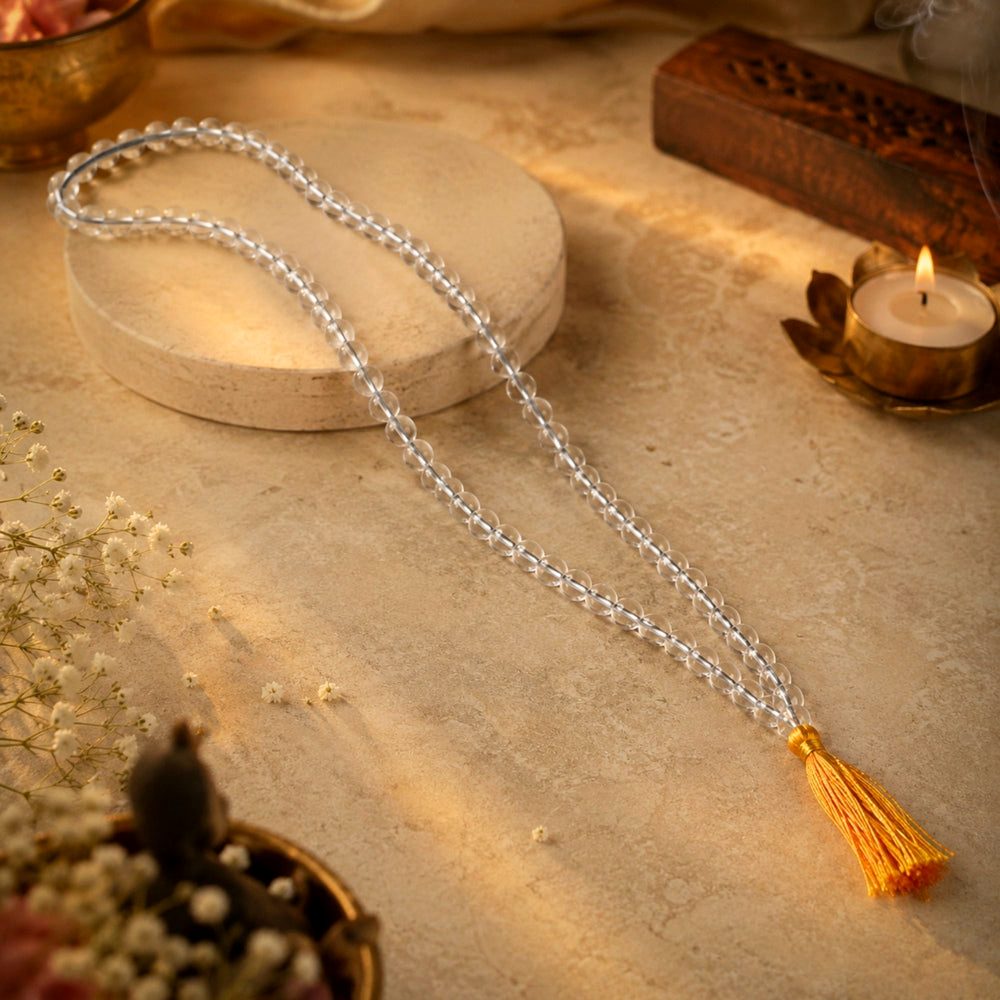
Clear Quartz (Sphatik) Mala — 8mm
A natural clear quartz mala with natural inclusions.
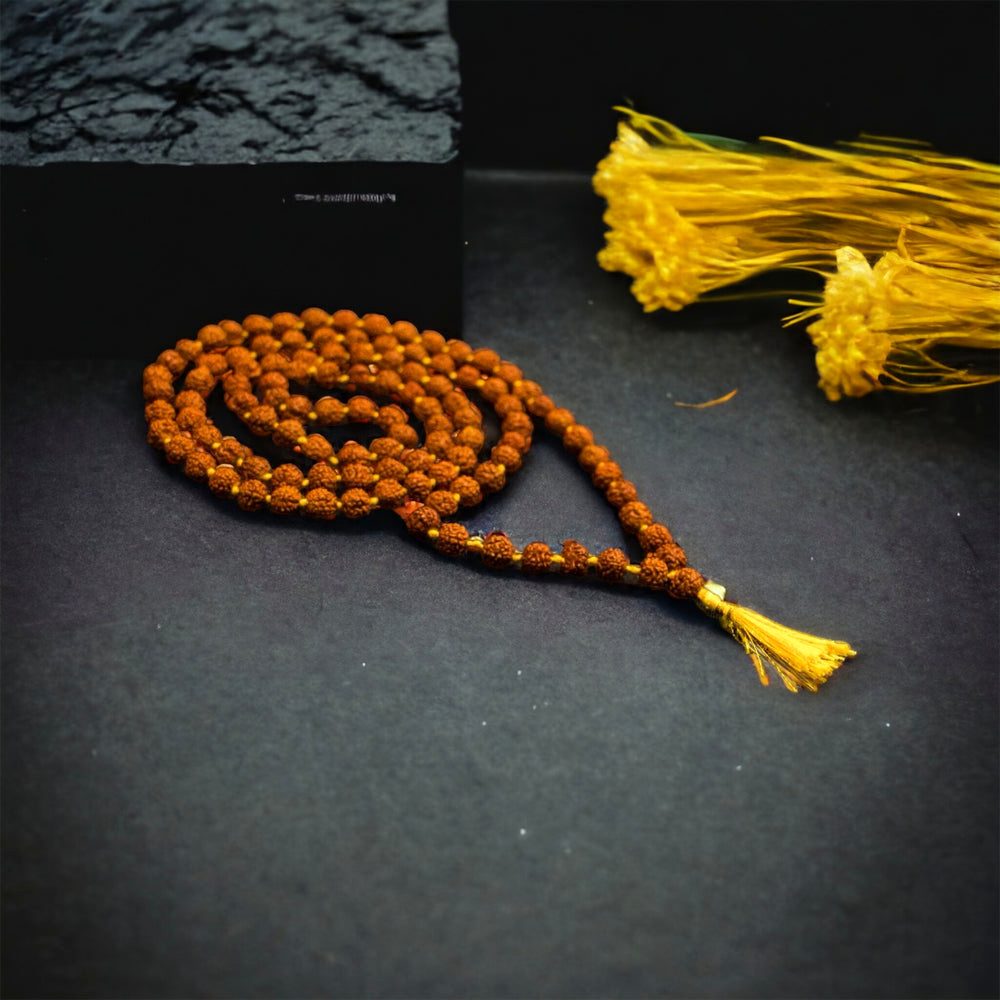
Rudraksh Mala — 109 Beads
A knotted rudraksha mala with 109 beads for japa and prayer.
What do buyers ask us?
Will a sphatik mala cool my body or treat any illness?
No. Those are traditional beliefs about sphatik, and no clinical evidence supports medical claims for quartz. The mala's verifiable qualities are its material, its count and its making — buy it on those, and for your practice.
Are inclusions a sign of low quality?
No — the opposite, up to a point. Inclusions are how natural quartz normally looks; a flawless bead at a low price is the one to question. Very heavy, milky inclusions are a matter of taste, not of authenticity.
Quartz is used in watches — does the mala do something similar?
No. Watch quartz is a precisely cut crystal in an electronic circuit, chosen because an electric current makes it vibrate steadily. A bead on a thread has no circuit and no such effect, and the comparison is marketing, not physics.
Can I wash my sphatik mala?
Wipe the beads with a damp cloth if needed, but do not soak the mala — the cord is what suffers. Keep perfume and chemicals away from the stringing.
Why does your mala cost more than 'sphatik' malas I see for very little?
Because most very cheap 'sphatik' is glass. Natural quartz, drilled and strung to a full 108 + 1 count, costs more to make; the inclusions stated on our page are the visible difference.
Mineral facts (silicon dioxide, Mohs 7) are standard mineralogy for quartz and are stated so a buyer can check them against any reference.
The clarity scale summarises the grades commonly met in the Indian bead trade: what each level usually means for authenticity and price.
Traditional associations are described as tradition throughout; no medical or outcome claim is made for this product.
More product education on the Rudra Sacred blog. For astrology and festival guides, see the separate Astro Sacred blog at astrosacred.store.