Rudraksha Mala Guide: Counts, Knots and Care
A rudraksha mala is a string of natural rudraksha seeds used to count mantra repetitions, called japa. A full mala carries 108 counting beads plus one guru bead — 109 in total. Knotting between beads protects them and makes counting easier. The count and the stringing are practical choices; no mala is sold here with a promise of results.
| Bead count | 108 counting beads + 1 guru bead = 109 beads |
|---|---|
| Our mala | 109 beads, knotted between beads, no tassel |
| Bead material | Natural rudraksha seed |
| Guru bead | The one bead the counter does not cross during japa — the turn-around point |
| Traditional use | Counting mantra repetitions (japa); also worn |
| Care in one line | Keep dry, away from perfume and chemicals, stored in a pouch |
| Evidence note | A mala is a counting tool within a practice; its meanings are traditional |
| If you want | Choose | Why |
|---|---|---|
| A full mala for japa at home | The 109-bead knotted mala | Full 108 count for a complete round of japa; knots keep beads apart and counting steady |
| Rudraksha you wear through the day | A rudraksha bracelet | A bracelet sits on the wrist all day; a long mala is usually kept for practice or worn under clothing |
| A first mala, and you are unsure | The knotted mala | Knotting protects the beads from rubbing and makes the count easier to keep — the forgiving option |
| A mala mainly as a kept object for puja | The 109-bead mala, stored in its pouch | A full-count mala is the traditional form kept with puja items |
What is a rudraksha mala?
A rudraksha mala is a closed string of rudraksha seeds. In tradition it is used for japa: the practitioner repeats a mantra and moves one bead for each repetition, so the mala works as a counter that the fingers read without looking. That counting job is why the number of beads, and how they are strung, matter more than decoration.
The seeds themselves are natural produce, so a real mala shows small differences between beads — in size, in colour, in the depth of the grooves. A mala of perfectly identical beads should prompt a question, because nature does not turn out identical seeds.
Why 108 beads, and what is the guru bead?
The 108 count is a traditional number in Indian practice, used across mala traditions, and a full round of japa is one pass through the 108 counting beads. The extra bead — the guru bead, sometimes called the meru — is not counted. When the fingers reach it, the practitioner turns the mala around rather than crossing it, and begins the next round.
Our mala is built exactly on that pattern: 108 counting beads plus one guru bead, 109 beads in total. If you are comparing malas between sellers, ask for both numbers — a mala sold as '108' sometimes includes the guru bead inside the 108, which shortens the actual counting round.
Knotted or unknotted — which should you choose?
In a knotted mala, a small knot of the cord sits between every pair of beads. The knots stop the seeds rubbing against each other, hold the spacing when a bead is moved, and mean that if the cord ever breaks, the beads do not all scatter. Counting is also easier, because each bead sits in its own place.
An unknotted mala is simpler and slightly cheaper to string, and some practitioners prefer the beads running freely. For daily japa and for a first mala, knotted is the practical choice — it is how our 109-bead mala is made. For a bracelet, look at the rudraksha bracelets in our range, including a knotted bracelet strung on the same principle.
Does the mukhi of a mala bead matter?
Mala beads are almost always 5 Mukhi — in tradition the most widely worn mukhi, and the form that grows commonly enough to string a full mala from matched natural seeds. Our mala and our rudraksha bracelets use 5 Mukhi beads.
Malas strung from rare mukhis exist in the market at very high prices, and a buyer should ask hard questions there: a full 108 of a rare form means 108 rare seeds, and the authenticity checks in our mukhi guide apply bead by bead. For practice, the tradition itself has always centred on the common 5 Mukhi mala.
How do you care for a rudraksha mala?
Keep the mala dry. Water, sweat, perfume and soap dull the seeds and rot the cord over time, so take it off for bathing and store it in a cloth pouch. Many wearers oil the beads occasionally with a plain oil, as a customary practice against drying; wipe away the excess.
Cord and knots wear with daily counting; re-threading a mala after a few years is normal maintenance, not a defect, and any local jeweller or mala maker can do it. If a bead cracks, it can be replaced during re-threading — the count is what matters, so replace like with like.
How do you shortlist a mala in three questions?
One: is it for japa, for wearing, or for keeping in puja? Japa points to the full 109-bead mala; daily wearing points to a bracelet. Two: knotted or unknotted? For counting and durability, knotted. Three: does the listing state the count honestly — 108 counting beads plus the guru bead, and the mukhi of the beads?
A listing that answers all three plainly is a listing you can buy from with your eyes open.
Before you buy a rudraksha mala, check three things. The count: 108 counting beads plus one guru bead, stated separately. The beads: natural variation in size and groove depth, not identical copies. The stringing: knots that sit evenly between beads, and a guru bead that is easy to find by touch.
Natural darkening of the seeds with use is expected and is not a fault.
Products in this guide
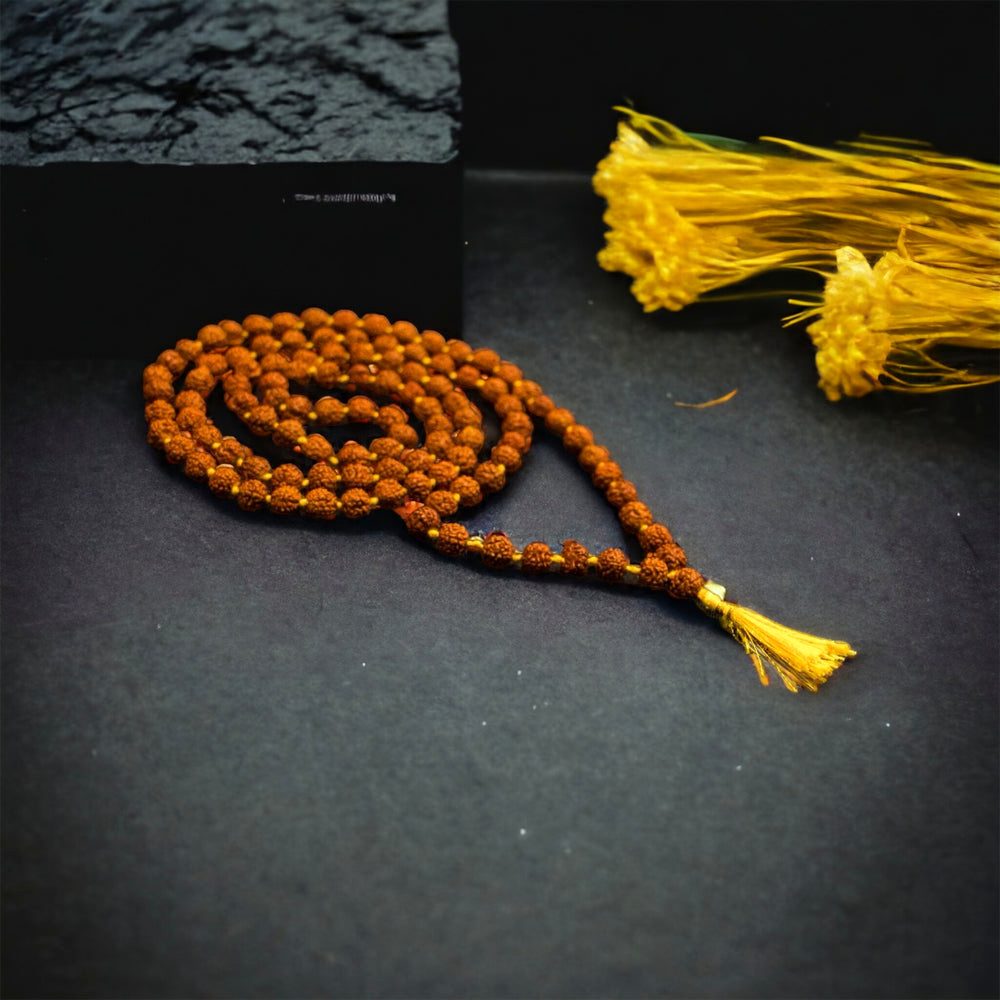
Rudraksh Mala — 109 Beads
A knotted rudraksha mala with 109 beads for japa and prayer.
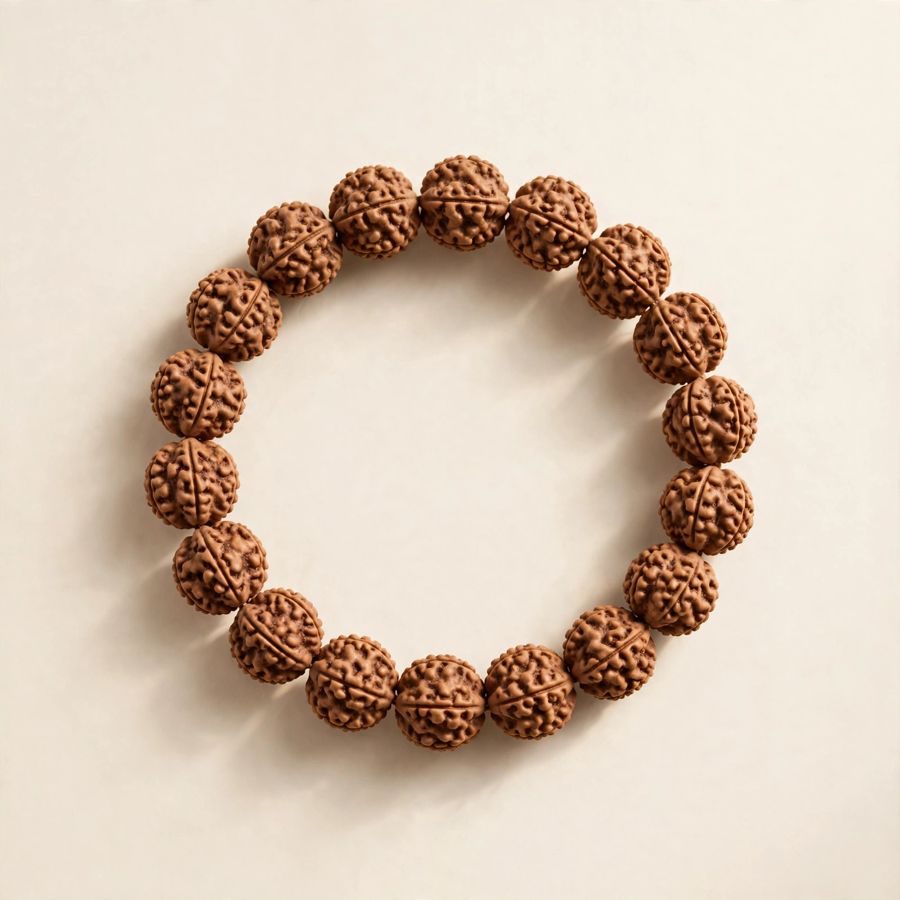
5 Mukhi Rudraksha Bead Bracelet
A bracelet of 5 mukhi rudraksha beads.
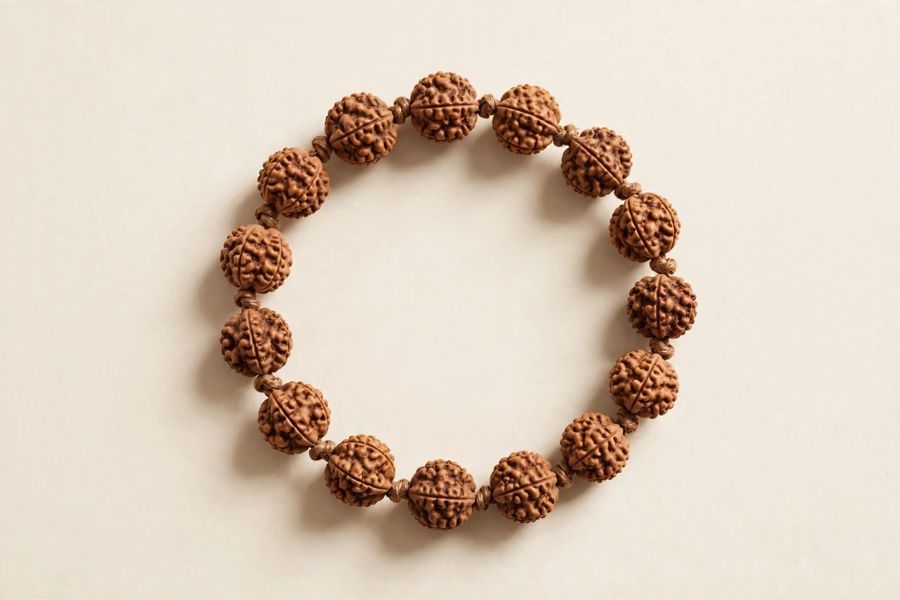
Rudraksha Knot Bracelet
A knotted rudraksha bracelet.
What do buyers ask us?
Will japa with this mala bring me peace or success?
No mala can be promised to do that. A mala is a counting tool inside a practice; what the practice does for a person is a matter of their own discipline and belief. We sell an honestly counted, well-strung mala — the practice is yours.
Why does the mala have 109 beads if the count is 108?
Because the 109th bead is the guru bead, the turn-around point that is not counted. 108 counting beads plus 1 guru bead is the full traditional stringing.
Can I wear the mala every day?
You can, and many people do. Keep it dry, take it off for bathing, and expect the cord to need re-threading in time. If you want rudraksha purely for all-day wear, a bracelet is the more practical form.
My beads are not all the same colour. Is that a defect?
No. Natural seeds vary in colour, size and markings, and darken unevenly with wear. Uniform, identical beads are the warning sign, not variation.
What if the cord breaks?
With a knotted mala the beads stay on the cord sections and are easy to gather. Re-threading is normal maintenance; keep the guru bead aside and have the mala restrung to the same 108 + 1 count.
The 108 + 1 stringing and the guru-bead convention follow the standard japa mala pattern used across Indian mala traditions.
More product education on the Rudra Sacred blog. For astrology and festival guides, see the separate Astro Sacred blog at astrosacred.store.