Gomti Chakra & Yellow Kaudi Guide
Gomti Chakra is a natural shell marked with a spiral, linked in tradition to the Gomti river and the Sudarshan Chakra; kaudi is the cowrie shell once used as money in India and still a Lakshmi puja staple. Sets of 11 or 21 are customary, never required. Both are symbols inside a puja, not mechanisms that change outcomes.
| Gomti Chakra | A natural shell with a flat spiral marking on one side |
|---|---|
| Yellow kaudi | A cowrie shell in its yellow form, with the toothed slit of all cowries |
| Customary sets | 7, 11 or 21 pieces — customary numbers in puja practice, not a rule |
| Traditional uses | Lakshmi puja (Diwali, Dhanteras), altar arrangements, kept in cash boxes by custom |
| The natural check | A real spiral is uneven and grows with the shell; replicas are moulded and identical |
| Form sold here | Loose natural shells — see each product page for its pack details |
| Evidence note | Ritual items with traditional meanings; no financial effect is claimed |
| If you want | Choose | Why |
|---|---|---|
| A Diwali or Dhanteras Lakshmi puja set | 11 or 21 yellow kaudi, with Gomti Chakra | The customary set sizes used in Lakshmi puja arrangements; the guide's layout section shows a simple arrangement |
| Shells to keep in a cash box or tijori, by custom | A small set of 7 | The customary keeping practice uses a small odd-numbered set; 7 is the common small count |
| An altar or puja-plate arrangement | A mixed set of Gomti Chakra and kaudi | The two shells are traditionally arranged together on the puja plate and around a Lakshmi-Ganesha seat |
| A single keepsake or a replacement piece | One Gomti Chakra | A single spiral shell is the traditional keepsake form; there is no minimum a custom demands |
What exactly is a Gomti Chakra?
Gomti Chakra is a small natural shell, found in river beds — in tradition, above all the Gomti river — with a flat spiral pattern on one side. The spiral is what gives the shell its name and its place in puja: in tradition it is read as a likeness of the Sudarshan Chakra, Vishnu's discus, and the shell is kept as an auspicious object in its own right.
Each shell is a natural object, so no two spirals are alike: the whorl sits slightly differently, the shell's weight and cream-brown colouring vary. That irregularity is not a flaw in a ritual shell — it is how you know the shell grew rather than being moulded, a point the authenticity section returns to.
What is a kaudi, and why yellow?
Kaudi is the cowrie shell — glossy, oval, with a long toothed slit along its underside. Cowries were used as money across India and much of the world for centuries, and that history is why the shell never left the puja room: in tradition it is one of Lakshmi's own emblems, wealth in its oldest portable form.
Cowries come in white and in a yellow form. The yellow kaudi is the traditional choice for Lakshmi puja — at Diwali and Dhanteras it is the form most families reach for, and it is the form our listing carries. In games and older customs white cowries appear too; for puja sets, yellow is the customary one.
How many do you need — 7, 11 or 21?
Customary puja sets run in odd numbers — 7, 11, 21 — and you will see those counts across the market because they are the counts families actually use. But customary is not compulsory: no text fixes a number that a puja fails without, and a smaller set used with attention is not a lesser puja.
Choose by use. A puja-plate arrangement for Diwali wants enough shells to lay out — 11 or 21. A cash-box keeping set is small — 7 is common. A single Gomti Chakra as a keepsake needs no companions at all. The decision table above lays the choices out in that order.
How can you tell a natural shell from a resin replica?
Replicas exist because natural shells take collecting and sorting. Three checks expose most of them. The spiral: a natural Gomti spiral is slightly off-centre and uneven in depth, grown into the shell; a moulded spiral is perfectly centred and identical from piece to piece. The surface: shell is cool, dense and matte-to-silky; resin feels warm, light and plasticky-glossy. The set: lay the pieces side by side — natural shells all differ a little, replicas repeat.
For kaudi, check the slit: a real cowrie's teeth are irregular, chipped here and there by its life; a cast copy has machine-even teeth. Buying from a seller who states plainly that the shells are natural — and whose photos show variation between pieces — is the practical version of the same check.
Where do people keep them?
In the puja space, first of all: on the puja plate at Diwali and Dhanteras, arranged around the Lakshmi-Ganesha seat, often on a red or yellow cloth with the kaudi in a small heap and the Gomti Chakra laid spiral-up beside them. The same pair appears inside composite pieces — our Laxmi Kuber Pujan Box carries both shells among its contents, which is the traditional combination in a ready-made form.
By custom, sets are also kept where money is kept — a cash box, a tijori, a shop's cash drawer — as a kept symbol, in the same spirit as the puja use. And they are stored between festivals in a clean cloth inside the puja cupboard, not loose in a kitchen drawer; natural shells are hard but the spiral face can chip if they rattle against metal.
Before you buy loose shells anywhere, use the checks in this guide: uneven natural spirals, cool dense shell rather than warm light resin, irregular cowrie teeth, and visible variation across the set. Identical pieces at a very low price are the replica signature.
Gomti Chakra and yellow kaudi are natural shells, sold loose; natural variation in spiral, colour and size is expected.
Products in this guide
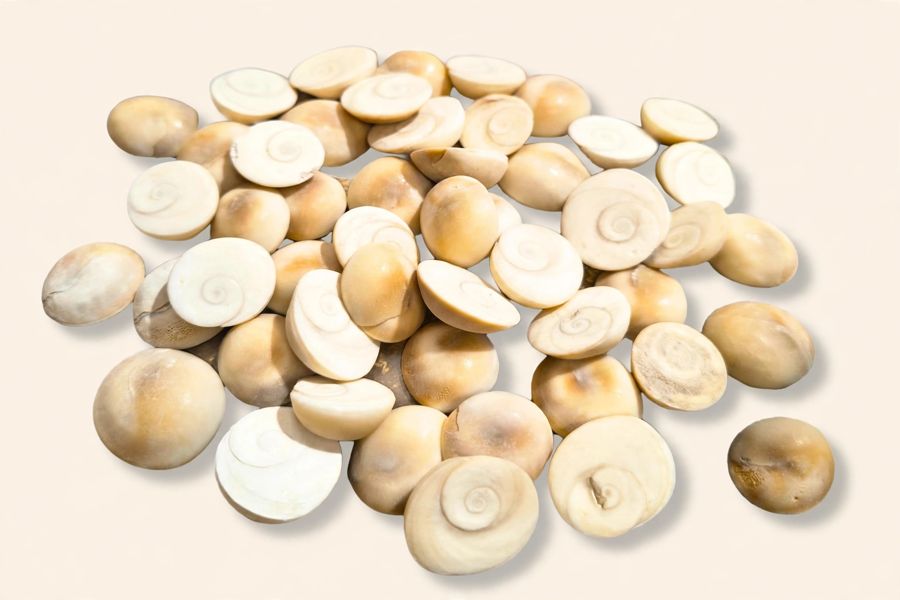
Gomti Chakra (Loose)
Loose Gomti Chakra shells for puja use.
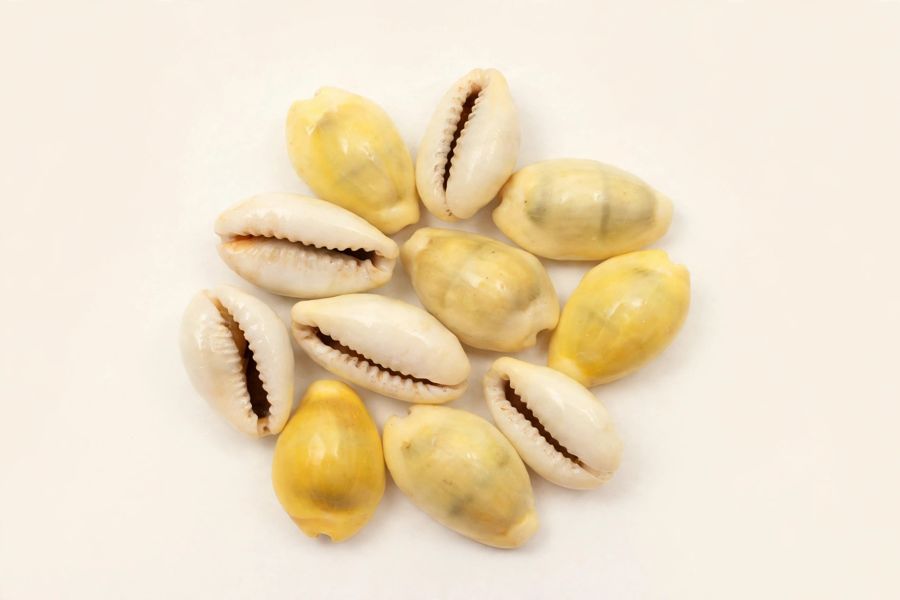
Yellow Kodi (Kaudi)
Yellow kaudi shells, traditionally used in Lakshmi puja.
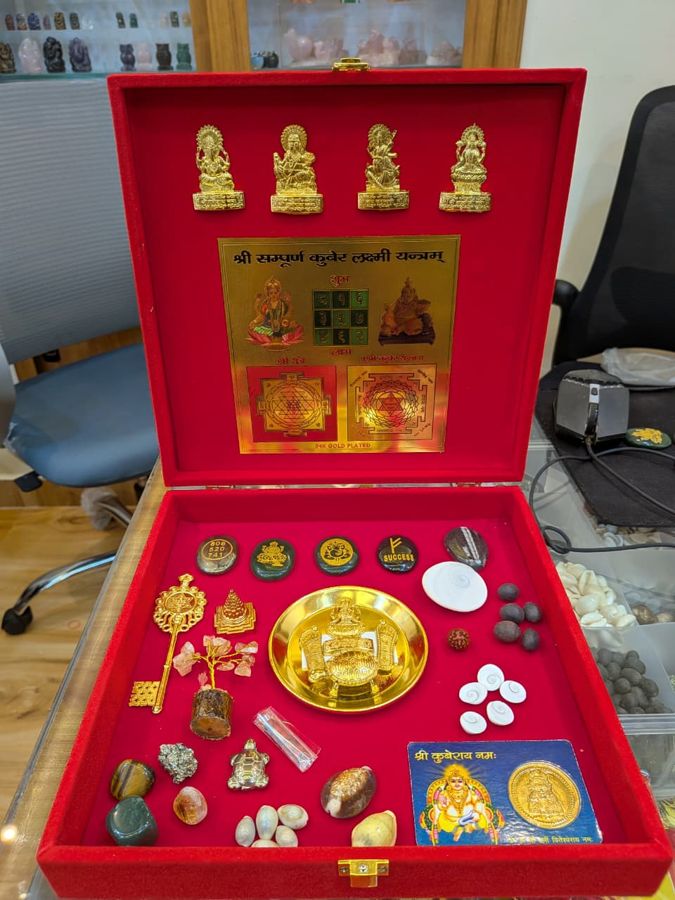
Diwali Special Laxmi Kuber Pujan Box
A complete puja box for Lakshmi-Kuber puja at home, in a red velvet box.
What do buyers ask us?
Will keeping kaudi in my cash box increase my income?
No. The cash-box practice is a custom — a symbol kept where money is kept. Symbols do not change income. Buy them for the puja and the custom, which are real things.
Must the set be exactly 21?
No. 7, 11 and 21 are customary counts, not requirements. Choose the count that fits the use — a small keeping set or a full puja layout — as the decision table in this guide sets out.
Can I use a shell with a small chip in puja?
Custom prefers whole, unbroken shells for puja, and most families would move a chipped shell out of the main set. Whether a lightly chipped shell stays in your puja is a family-practice call; for a new set, you should receive whole shells.
How do I clean the shells?
Rinse briefly in plain water and dry fully in shade before storing or using — natural shell tolerates water; it lives in it. Do not use bleach or acids, which eat the surface. Store dry, in cloth.
Are Gomti Chakra and kaudi the same thing?
No — they are two different shells that are often used together. Gomti Chakra carries the flat spiral; the kaudi is the cowrie with the toothed slit. This guide covers both because puja sets so often combine them.
The Gomti river and Sudarshan Chakra association and the cowrie's history as currency are the standard traditional accounts for these shells, and are presented here as tradition and history, not as effects.
Set counts (7, 11, 21) are reported as the customary counts in current puja practice; this guide states plainly that they are customary, not required.
More product education on the Rudra Sacred blog. For astrology and festival guides, see the separate Astro Sacred blog at astrosacred.store.